
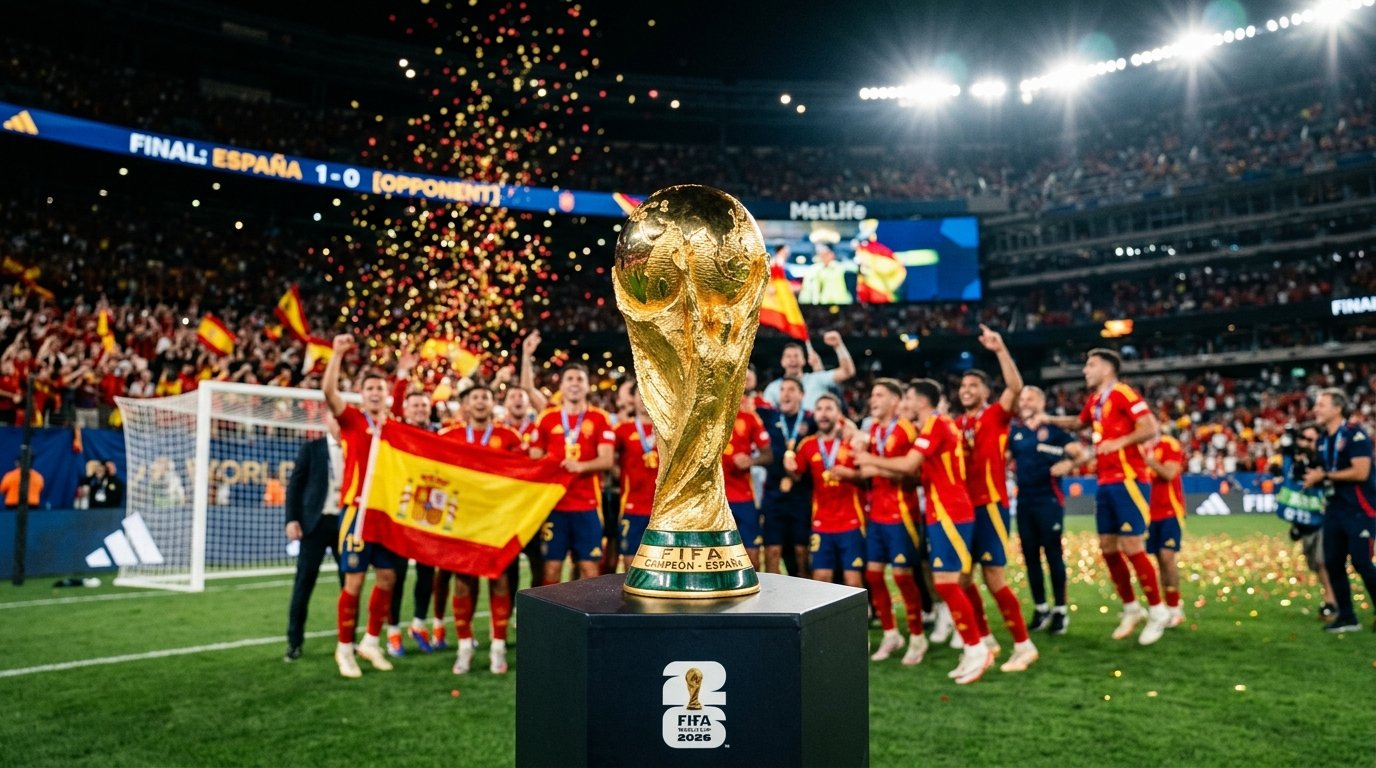
Spain Wins the 2026 World Cup
Football has a new world champion, and the story behind the Spain 2026 World Cup win is one of patience, discipline, and a defense so airtight it rewrote the record books. On Sunday, July 19, 2026, Spain defeated Argentina 1-0 after extra time at MetLife Stadium in East Rutherford, New Jersey, to lift the FIFA World Cup trophy for the second time in the nation’s history. If you’re searching for the full story of the Spain vs Argentina World Cup final, the goal that decided it, and what this title means for both nations, here’s everything you need to know.
Spain’s Road to the Final: A Defensive Masterclass
Long before the final whistle blew in New Jersey, the story of this Spain squad had already been written in the numbers. Spain became the first World Cup champion in history to win the tournament while conceding only a single goal across the entire competition. That lone goal came against Belgium in the quarterfinals, and it stands as a remarkable anomaly in an otherwise flawless defensive campaign.
Coach Luis de la Fuente built his side around control, and it showed in every match. Spain dominated possession game after game, suffocating opponents and rarely allowing space for counterattacks. This wasn’t the free-flowing, goal-hungry tiki-taka of the 2010 golden generation. This was a more measured, ruthlessly efficient version of Spain’s national football team, built to grind results out rather than overwhelm opponents with flair alone.
Much of that balance came from a mix of experience and youth. Nineteen-year-old sensation Lamine Yamal, who had already helped Spain win the European Championship in 2024, continued to be a driving force in the attack. Meanwhile, veteran midfielder Rodri anchored the team from midfield, eventually lifting the trophy as captain in one of the defining images of the tournament.
Inside the Final: Spain vs Argentina at MetLife Stadium
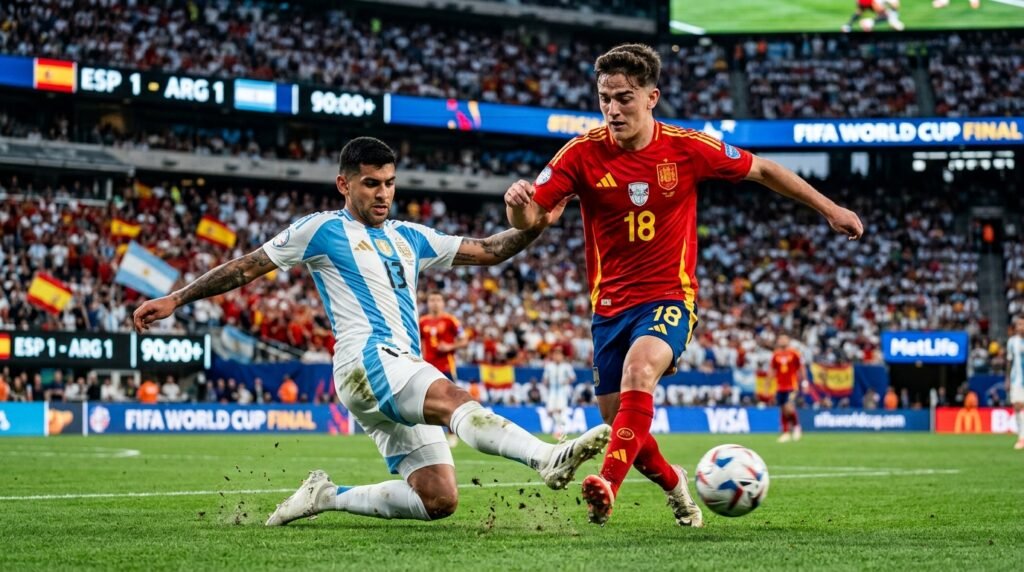
The 2026 World Cup final between Spain and Argentina lived up to its billing as a heavyweight clash, even if the football itself was, by several accounts, a tense and difficult watch. Argentina, the defending champions chasing back-to-back titles for the first time since Brazil in 1962, set up to frustrate Spain and rely on quick transitions.
For 90 minutes of regulation time, that plan worked. Argentina’s back line, marshaled brilliantly by goalkeeper Emiliano Martínez, held firm against wave after wave of Spanish pressure. Spain’s attackers found crosses blocked, shots deflected, and passing lanes cut off by desperate Argentine defending. It was a masterclass in resilience from a team that had made a habit of winning ugly when it mattered most.
But possession and shot totals told a different story than the scoreline. By the end of the match, Spain had fired off 20 shots to Argentina’s two, with 12 of those on target. Argentina, remarkably, didn’t register a single shot until the second half of extra time. The gulf in control was enormous, yet for nearly two hours, one man stood between Spain and the trophy.
Emiliano Martínez’s Historic Performance in Goal
Any recap of this World Cup 2026 final has to center on Emiliano Martínez’s goalkeeping. The Argentine shot-stopper delivered a performance for the ages, finishing the match with 11 saves, a new record for the most saves ever recorded in a men’s World Cup final. He broke the previous championship-game save record before the match had even reached its final stretch, somehow continuing to deny Spain chance after chance as fatigue set in around him.
For long stretches, it looked like Martínez alone might be enough to drag Argentina to a penalty shootout, or even force a stunning upset. His performance turned what could have been a routine Spanish victory into one of the most tension-filled finals in recent World Cup memory.
Ferran Torres Delivers the Winning Goal
With the match locked at 0-0 through 90 minutes and deep into extra time, Spain finally broke through. In the 105th minute, Nico Williams headed a pass into space, and Ferran Torres met it with a clinical finish that beat Martínez and sent the Spanish bench into delirium. It was Spain’s 12th shot on target of the night, the one that finally found the breakthrough after nearly two hours of relentless pressure.
Speaking after the match, Torres described the moment simply, saying he saw the ball arrive and struck it with everything he had. That single goal was enough. Argentina, needing a response, pushed forward but could not find an equalizer, and Spain held on to seal their 1-0 World Cup final win.
The result was compounded by late controversy, as Argentina’s Enzo Fernández received a second yellow card and was sent off in stoppage time following a challenge on Spain’s Pau Cubarsí, leaving Argentina to finish the match a man down and further cementing Spain’s control over the closing moments.
The End of an Era for Lionel Messi and Argentina
For Argentina, this final marked what Lionel Messi had already indicated would be his last World Cup appearance. Messi finished the tournament with eight goals and four assists, a remarkable individual haul, but the fairytale ending of a repeat title eluded him and his country. Argentina had been chasing history of their own, hoping to become the first team to win four consecutive major tournaments after their Copa América titles in 2021 and 2024 and their World Cup win in 2022.
Instead, the tournament ended quietly for Messi and his teammates, with Argentina managing to muster almost nothing in attack against a Spanish defense that simply refused to break. It’s a bittersweet coda to one of the greatest careers in football history, and one that will be debated by fans for years to come.
What Spain’s Second World Cup Title Means
This championship marks Spain’s second World Cup title overall and their first since the iconic 2010 team lifted the trophy in South Africa. For manager Luis de la Fuente, the win adds to an already remarkable managerial resume; he improved to 14 wins, 0 losses, and 1 draw since taking charge of the national team, and became the oldest manager ever to win a World Cup.
The victory also reinforces Spain’s status as the dominant force in international football heading into the next cycle, having already claimed the European Championship in 2024 before backing it up with the sport’s biggest prize in 2026. With a young core led by Lamine Yamal and a proven tactical setup under de la Fuente, this Spain World Cup champions 2026 squad looks poised to remain among the best teams in the world for years to come.
A Final Worthy of a Global Stage
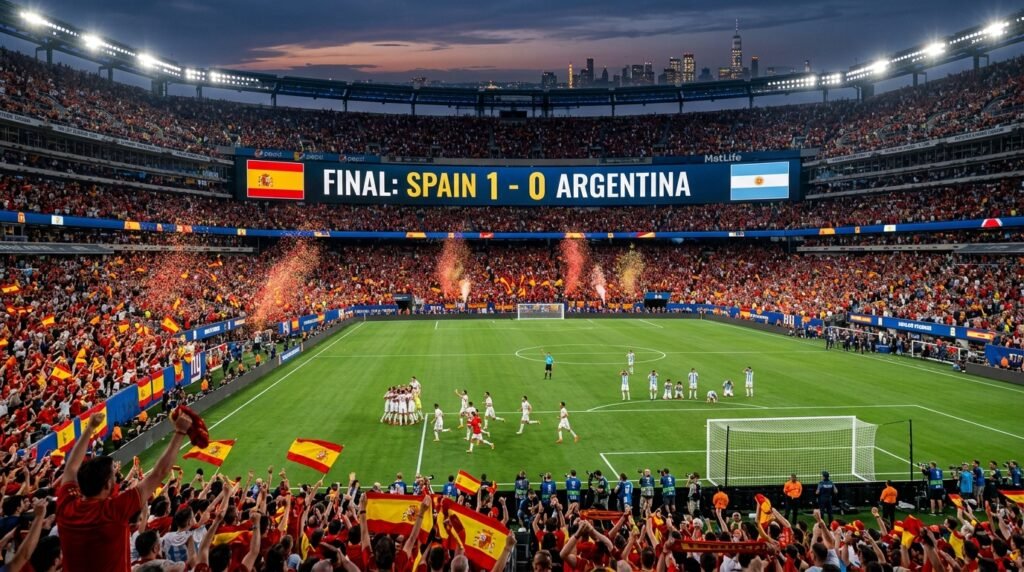
Beyond the football itself, this FIFA World Cup 2026 final carried enormous ceremonial weight as the closing chapter of North America’s first men’s World Cup in over three decades, co-hosted across the United States, Canada, and Mexico. More than 70,000 fans packed MetLife Stadium, with a star-studded halftime and closing ceremony featuring performers like Shakira, Post Malone, and Tom Cruise adding extra spectacle to an already historic night.
For Spain, all the spectacle in the world couldn’t compare to the substance of their achievement: a tournament run built on defensive discipline, conceding just one goal in eight matches, capped off by a hard-fought extra-time winner on the sport’s biggest stage.
Final Thoughts
The Spain vs Argentina 2026 World Cup final will be remembered as a triumph of control over chaos. Spain didn’t dazzle with an avalanche of goals, but their suffocating defense, patient buildup play, and clinical finishing when it mattered most proved decisive against an Argentina side desperately trying to make history of its own. With Ferran Torres’ extra-time strike and Rodri lifting the trophy as captain, Spain’s second World Cup title is a fitting reward for a squad that quietly dominated an entire tournament without ever needing to overwhelm anyone with flash.
As international football turns the page toward the next cycle of major tournaments, Spain enters as the team every other nation will be chasing.
Stay tuned for more World Cup 2026 recaps, player analysis, and tournament retrospectives right here on the blog.